During July and August sow a few rows of Carrots using the variety Eskimo. This is an excellent variety which can stay in the ground throughout Winter and can be used as-and-when needed.
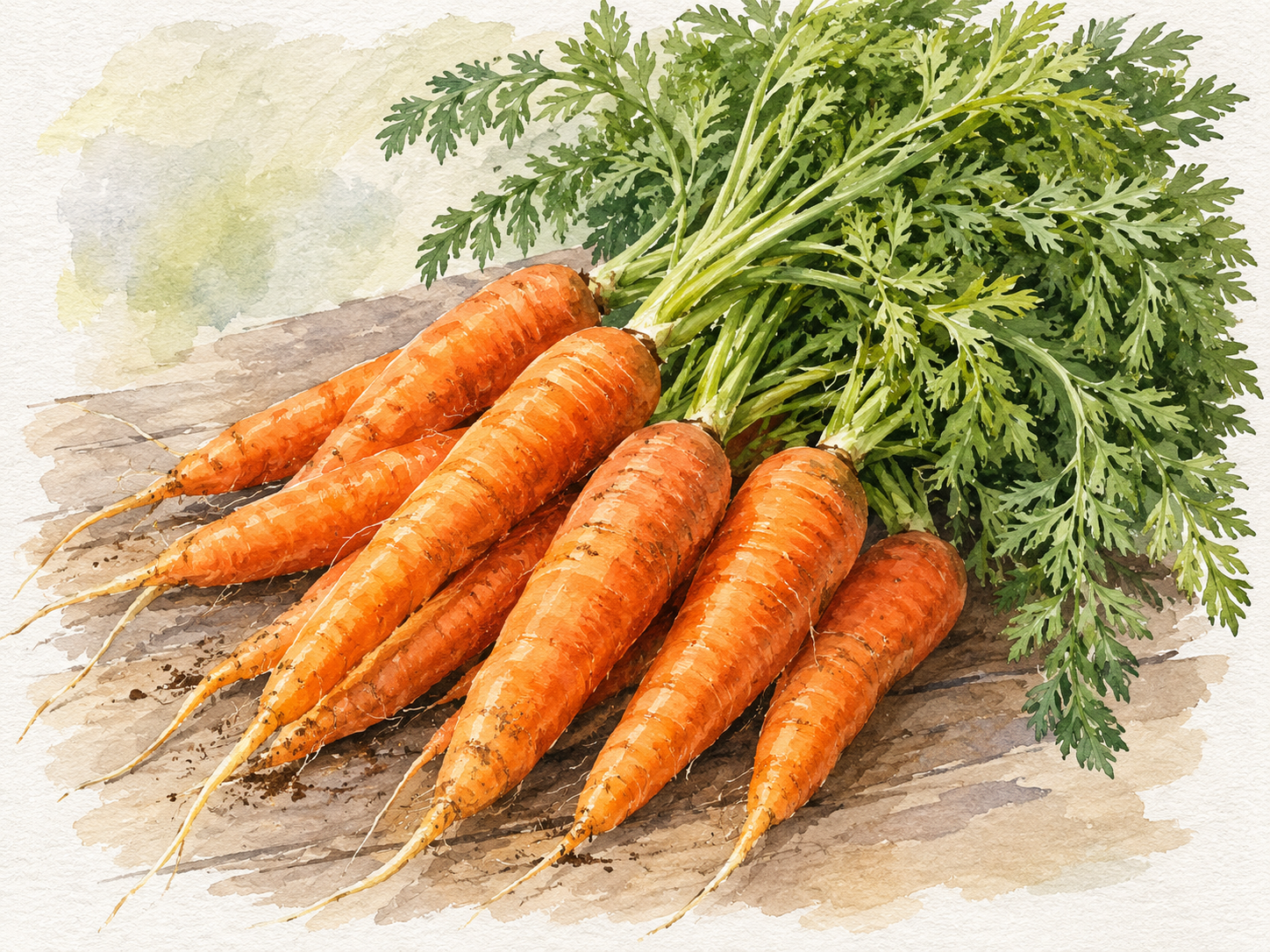
‘Eskimo’ is an F1 hybrid maincrop carrot bred with good cold tolerance. It produces fairly long, smooth, cylindrical-to-tapered orange roots and is particularly valued for Autumn and Winter harvesting.
It’s a handy variety if you want carrots later in the year rather than having everything ready in Summer.
Sowing in July
July is an excellent time for a late crop. Sow the seed directly where the carrots are going to grow. Carrots dislike being transplanted because disturbing the taproot can produce forked or misshapen carrots.
Make a shallow drill around 1–1.5 cm deep, sow the seed thinly and leave about 30 cm between rows. Once the seedlings establish, aim for roughly 5–8 cm between plants for decent-sized roots.
With a July sowing, you can generally expect to start lifting carrots during October and November, depending on conditions and exactly when you sow.
Sowing in August
For an August sowing, I’d sow as early in the month as possible. By late August, falling temperatures and shortening days mean growth becomes much slower.
An early-August sowing could give you smaller carrots in late Autumn into Winter. In a cooler, wetter area, I’d regard mid-to-late August sowings as more experimental — you may get worthwhile roots, but don’t expect the same size as a June or July sowing.
Why Eskimo works for Winter
Its big advantage is cold tolerance. Established roots can be left in the ground later than many varieties, giving you a crop to lift as you need it.
A layer of straw, leaves or horticultural fleece over the bed as Winter approaches can help protect the soil and make harvesting easier. The bigger issue in a very wet Winter can actually be waterlogged soil and slug damage rather than cold.
One thing I’d definitely do: protect against carrot fly
Carrot fly can still be active during these late sowings. The simplest approach is to cover the bed immediately after sowing with fine insect mesh and leave it covered.
Avoid thinning if you can by sowing very thinly. When carrot foliage is crushed or disturbed during thinning, the smell can help attract carrot fly.
For a July–August Eskimo crop, I’d do this: sow one row/batch in early July, another around late July, and a final smaller batch in the first week or two of August. That should stagger your harvest nicely through Autumn and into Winter.